
Running several Claude Code sessions in parallel works well until one of them stops to ask for permission and you don't notice for twenty minutes. The fix is a signal you can see without switching windows: Claude Code's own notifications for a session or two, and a status display with one tile per session once you run more.
Why parallel sessions stall
Each Claude Code session runs in its own terminal tab or window. While it works, it needs nothing from you. Then it hits a permission prompt, asks a question, or finishes, and waits. With three or four sessions open, the waiting one is usually in a tab you aren't looking at.
The cost isn't the prompt itself. It's the minutes the session sits idle before you find it.
For why tracking many sessions is hard on your attention, and how many to run at once, see Running multiple AI agents at once without losing track.
Option 1: Claude Code's own signals
Claude Code already tells you when a session needs you, and for one or two sessions this is often enough.
- Agent view.
claude agentsopens one screen for your background sessions, grouped under Needs input, Working and Completed, so the session waiting for you sits at the top. It's a research preview, and it lists background sessions only: start one withclaude --bg "<prompt>", or type/bgin a running session. You can reply to a session from its peek panel, but a permission prompt still needs you to attach to that session and answer it there. See Claude Code agent view: run and watch background sessions for its groups, replies and limits. - Desktop notifications. When Claude finishes a task or pauses for a permission prompt while you seem to be away, it sends a notification. Ghostty, Kitty and iTerm2 show it as a desktop notification without setup.
- Terminal bell. In other terminals, set
"preferredNotifChannel": "terminal_bell"in~/.claude/settings.json. - Status in the terminal. Terminals that support the OSC 7501 status protocol show whether each interactive session is working, waiting or done. Claude Code 2.1.295 or later reports it automatically.
- The Claude desktop app. Its Code tab lists your sessions in a sidebar, so you can run several side by side, and it sends a desktop notification when a session finishes a task while you're not viewing it. A session you start from Dispatch on your phone sends a push notification there when it finishes or needs your approval. For research, documents and other work beyond code, Anthropic's other agent is Claude Cowork: see Claude Cowork vs Claude Code.
Anthropic compares its own ways to run tasks in parallel, from subagents to agent teams, on its Run agents in parallel page.
To enable experimental agent teams with a lead session, shared tasks and direct teammate messaging, see Claude Code agent teams: setup, display modes and tasks.
For setting up custom subagents, background Bash commands, /tasks and lifecycle hooks inside those runs, see Claude Code background agents: subagents, tasks and hooks.
To stop parallel sessions from editing the same files at once, see Git worktrees for parallel coding agents: Claude Code and Codex.
Inside each terminal window, you can also show the workspace, lines changed and cost with the Claude Code status line, though it hides while a permission prompt is open.
The limit: a notification tells you that something needs you, not which of six sessions it is, and it's gone once you dismiss it.
To compare tmux, notifications, hooks, IDE panels and a status pad, read How to monitor multiple Claude Code sessions.
Option 2: one tile per session
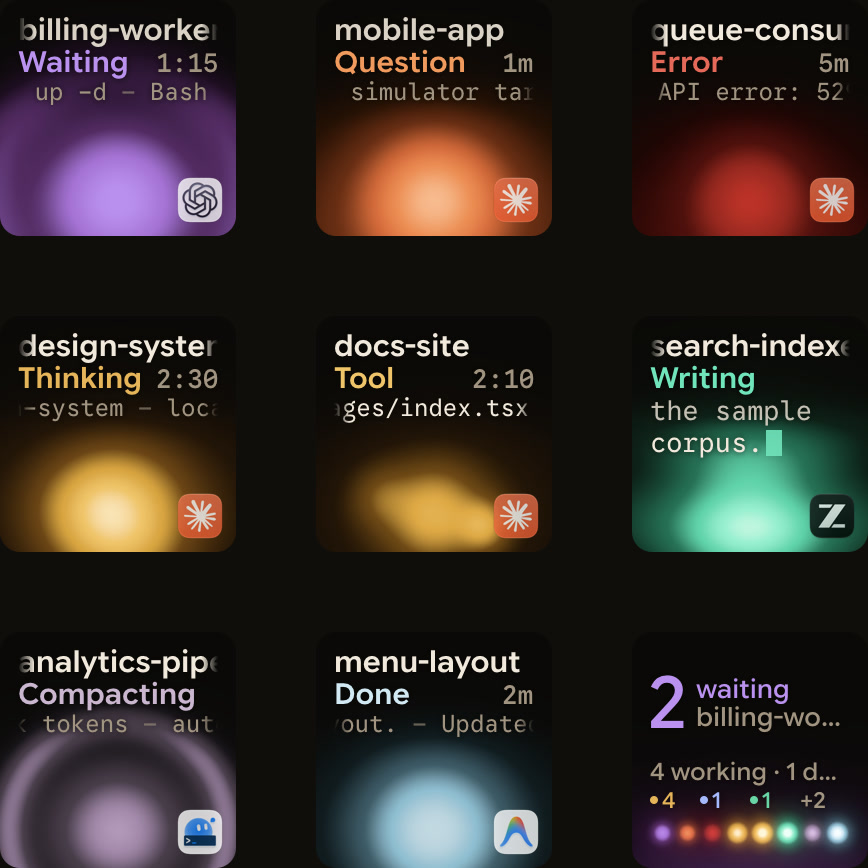
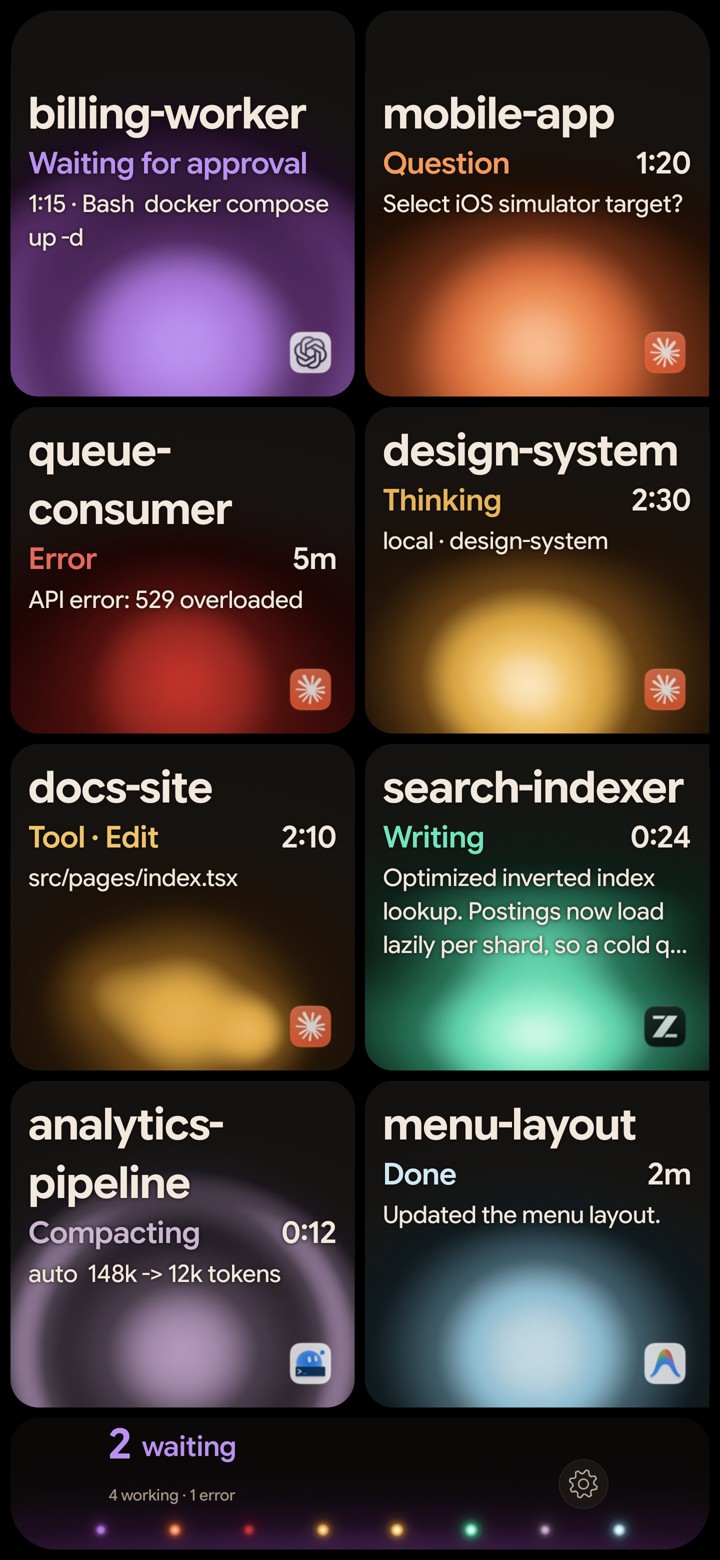
A status pad gives every session its own tile, always visible, next to your keyboard. Orbtile does this on an iPhone, an Android phone or on the Logitech MX Creative Keypad.
| What you want to know | Notifications | A tile per session |
|---|---|---|
| Something needs me | Yes, once | Yes, until you deal with it |
| Which session | Read the notification | The waiting tile moves to the front |
| What it's asking | Switch to the terminal | Shown on the tile |
| Answer without switching | No | Yes, for supported requests |
How it works with Orbtile:
- Each session gets a tile with its name, state (Thinking, Tool, Writing, Waiting, Done) and its latest words.
- Tiles sort by urgency: waiting sessions first, then working ones, then recent finishes, then idle ones. A new wait moves up at once.
- On the keypad or the phone, a tap opens that session's window on your computer, and a hold opens its focus view.
- For permission requests and multiple-choice questions, you can answer from the pad. Allow needs a hold of 0.6 seconds, so a stray tap never approves anything.
Set it up for Claude Code
- Install Orbtile on your Mac or Windows PC from the download page.
- In Orbtile, open Settings > Agents and install the Claude Code plugin.
- Restart any Claude Code session that was already running, once, so it picks up the plugin.
- Connect your pad: sign in and turn on Phone pad for the phone, or plug in the keypad.
The plugin talks to Orbtile over a private local socket on your computer. Your prompts, transcripts and code stay on your computer.
More than Claude Code
The same pad shows Codex, ZCode, Antigravity and Kimi Code sessions, sessions on remote servers over SSH, and any tool you connect through the Adapter API, on the Mac and on Windows. Each agent has its own colour, so you can tell them apart at a glance.
To see how Google's coding agent compares with Anthropic's across desktop apps, terminal tools and IDE extensions, read Google Antigravity vs Claude Code: what's the difference.
FAQ
Is this the same as Claude Code's agent view?
No. Agent view is a terminal screen for Claude Code's background sessions. Orbtile shows your sessions from any terminal and from servers over SSH, along with Codex, ZCode, Antigravity and Kimi Code, on a keypad or your phone, and you can answer a permission prompt from its tile: Deny with a tap, Allow with a hold. Turn on Show background sessions in Orbtile's settings to see agent view's background sessions there too.
How many Claude Code sessions can Orbtile show?
Eight per page, with the ninth tile as a summary that jumps to the first waiting session. With more than eight sessions, the pages flip.
Does it replace Claude Code's notifications?
No. Both keep working. The prompt in the terminal always works too, and whichever answers first wins.
Do I need the Logitech keypad?
No. An iPhone or Android phone works as the pad. The keypad adds physical keys.